Posted by Les Mauvaises Herbes

Does your skin feel as stretched as an over-washed sweater? Is it turning red, itching, or just sulking since winter showed up? What if what it needs grows right next door?
Around here, there are fields of sunflower, hemp and camelina. Forests of balsam fir. Patches of plantain, gardens of calendula and chamomile. And there’s even a plant from Ethiopia that decided to settle in Canada (Abyssinian!).
We’re introducing you to the local oils and plants we love, use… and sell, we won’t pretend otherwise! What’s in them, which boo-boo or which feeling we use them for, and what herbalism AND science have to say about them.
A quick note: “local,” for us, means grown, pressed or made in Quebec or elsewhere in Canada.
Our local oils, sold on their own
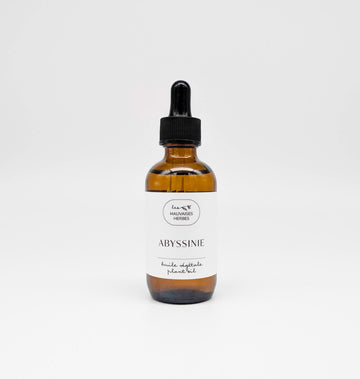
Abyssinian: silky skin
You know that satiny, gliding feel on your skin? Some formulators compare it to the feel of silicone, but this one is 100% plant-based. Abyssinian oil gives a dry, silky finish, zero greasy film.
For which boo-boo?
Dehydrated skin that’s lacking suppleness (it’s our big recommendation in our face routine), or unruly hair that frizzes (we use it in our anti-frizz recipes).
What’s in it
Mostly erucic acid (50 to 60%), a long-chain fatty acid that gives the oil its feel. Ours is cold-pressed and comes from Canada. And we gave it a whole article (yes, we’re fans): Abyssinian oil: what exactly is a “dry” oil?
In our recipes
You can also use it in our anti-frizz Abyssinian oil conditioner or our smoothing and strengthening hair serum. Bye bye, frizz.
Camelina: the gentle one
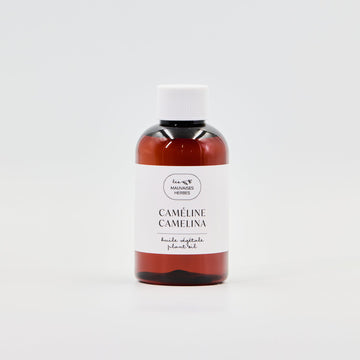
Sensitive, irritated skin that’s being grumpy? Meet your new best friend. Camelina is light, absorbs well and leaves no greasy film. In our practice, we love it for calming reactive skin.
What’s in it
An omega-3 champion (alpha-linolenic acid, 27 to 35%), with linoleic acid, oleic acid, very little erucic acid and lots of vitamin E (mostly gamma-tocopherol). It belongs to the same family as Abyssinian, mustard and cabbage: Brassicaceae. It’s nicknamed gold of pleasure, and its oil was used to light homes until the 18th century. No less.
Good to know
Ours is produced in Quebec, smells like freshly cut greenery, and loves the fridge.
In our recipes
Try it in our burdock and lavandin solid shampoo, our gardeners’ salve or our honey mask for damaged hair.
Hemp: the nourisher
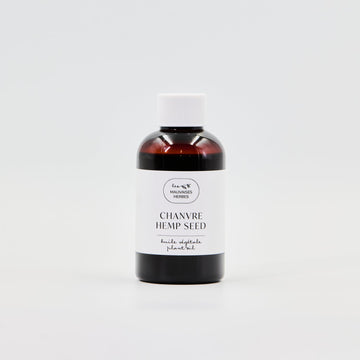
Dehydrated, dry, mature skin? Hemp has it covered. Its feel is dry: it nourishes without leaving your face as shiny as a frying pan. We love it in butters and serums for the face, lip balms and body butters.
What’s in it
Linoleic acid and alpha-linolenic acid (14 to 19% for the latter, depending on the studies), with gamma-tocopherol and beta-sitosterol as the main minor compounds. Ours is organic and cold-pressed in Quebec.
In our recipes
You can also use it in our summer face butter with mango and petitgrain, our eye makeup remover with rose and lavender or our whipped mango, castor and hemp butter.
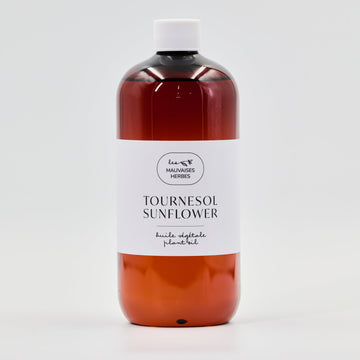
Sunflower: the all-rounder (and the secret behind our macerates)
It flies under the radar, but it’s our go-to oil. Deodorants, butters, balms, face and hair serums: our organic Quebec sunflower oil is all over our recipes. High oleic acid content, subtle scent, and it’s what we use as the base of our macerates. Which is exactly where we’re headed.
In our recipes
It’s the base of our homemade bath truffles (only 3 ingredients!) and our decadent vanilla oil maceration.
Macerates: the forest and the vegetable garden in a bottle
A macerate is an oil that spent a few weeks chatting with a plant. The result: the oil picks up its properties. It’s a pillar of herbalism, and a great way to bring what grows around us to your skin.
Feel like DIY? We explain everything (hot, cold, which plants, which oil) in Herbalism 101: making your own oil macerate. No time, no desire, no patch of plantain in your yard? Our macerates are made with fresh Quebec plants, hand-picked and macerated in our organic Quebec sunflower oil. They’re seasonal products: when they’re there, they’re there!
In herbalism, every plant has its properties, observed and passed down for a long time. For us, they’re worth as much as what’s measured in a lab.
Which macerate for which boo-boo?
- Calendula, the cuddle blanket. A powerful anti-inflammatory, healing and softening, say the herbalists. We love it for dry skin, sunburns and itching, and for sensitive skin, babies’ included. Try it in our silky repair oil, our chocolate lip balm or our homemade zinc salve for babies’ bums.
- Chamomile, the zen one. Soothing, softening, anti-inflammatory. For sensitive, irritated and reactive skin. We use it in makeup removers, salves and care for babies and kids. Try it in our nourishing cocoa butter bath bombs, our “croc skin” winter butter or our two-phase chamomile and aloe face serum.
- Plantain, the essential weed. Anti-itch and anti-inflammatory. For insect bites, itchy skin, and sensitive and dry skin. Try it in our all-powerful plantain anti-itch salve, our herbal salve for sore nipples or our honey salve.
- St. John’s wort, the summer handyman. Healing, it also soothes muscle aches and bruises. For sunburns, minor burns and skin irritations… and sore muscles (hello, pinched sciatic nerve). Try it in our cold sore oil, our sore-muscle balm or our moisturizing butter for lobster skin.
- Balsam fir, the winter favorite. Anti-infective, antispasmodic and toning. In respiratory salves (a must in winter), and in oils and balms for muscles. It smells like cotton candy. Yes, really. Try it in our balsam fir & black spruce decongestant salve, our winter body butter or our festive body scrub.
Balsam fir, knowledge that comes from here
Before landing in a bottle, balsam fir (Abies balsamea) was already in the pharmacy of many Indigenous nations. Ethnobotanical research on medicinal plants of the Canadian boreal forest reports, depending on the nation, resin applied to cuts, burns and wounds, and preparations for colds: among the Atikamekw, the Innu, the Algonquin, the Mi’kmaq, the Abenaki, the Cree and others. The Atikamekw also chew the sap, and the Abenaki use it as a mild antiseptic salve.
A historian, Jacques Mathieu, even suggested that balsam fir was the annedda, the tree said to have cured the scurvy of Jacques Cartier’s men. The hypothesis is debated, but admit it’s a great story.
This is living knowledge, observed, passed down and practiced by people who have lived with this forest for centuries. For us, it counts as much as any study.
The 5 oils face serum: local goodness in a bottle
The idea behind our 5 oils face serum? Put five local oils in the spotlight. No fluff: hemp, pumpkin, cranberry, Abyssinian, an extract of young balsam fir shoots, an active from tomato and apricot (for the exotic touch!) and vitamin E. Seven ingredients, for mature skin (or skin heading there) that likes simple formulas.
Who does what in there?
- Hemp: Firmness, suppleness, balance. Rich in linoleic and alpha-linolenic acids and in vitamin E, with a light feel.
- Pumpkin: Suppleness and elasticity. Made of oleic and linoleic acids, with tocopherols and delta-7 sterols, including spinasterol (which is also found in argan).
- Cranberry: Glow and antioxidant protection. It combines tocopherols and tocotrienols, two forms of vitamin E.
- Abyssinian: Smoothing, satiny finish, and our “VIP doorman” hypothesis (explained in its article).
- Balsam fir extract: A boost of tone, and its fresh, resinous, boreal notes.
Worth noting: we don’t sell pumpkin and cranberry oils on their own. For now, they’re only in this serum.

The cheat sheet for local oils
|
Oil |
Why we love it |
Leading fatty acids |
Where to find it |
|---|---|---|---|
|
Abyssinian |
Satiny finish, dehydrated skin |
Erucic (50 to 60%) |
On its own and in the 5 oils serum |
|
Camelina |
Sensitive and irritated skin, light finish |
Alpha-linolenic (27 to 35%) |
On its own |
|
Hemp |
Dry, dehydrated and mature skin |
Linoleic, alpha-linolenic (14 to 19%) |
On its own and in the 5 oils serum |
|
Pumpkin |
Suppleness and elasticity |
Linoleic (36 to 61%), oleic (21 to 47%) |
In the 5 oils serum |
|
Cranberry |
Glow and antioxidant protection |
Linoleic (35 to 40%), alpha-linolenic (20 to 35%) |
In the 5 oils serum |
|
Sunflower |
All-rounder, base of our macerates |
Oleic (high content) |
On its own and in our macerates |
Numbers vary depending on the variety, the origin and the pressing method: take them as orders of magnitude.
Quick how-to
Trying a new oil? Start with a few drops and adjust to what your skin likes. Oils rich in fragile fatty acids, like camelina and hemp, go rancid faster: keep them in the fridge, with a little vitamin E to protect them. Our macerates keep like a vegetable oil, away from light: all the details are in Herbalism 101.
FAQ
“Do I have to choose between local oils and oils from elsewhere?”
Not at all! They complement each other. We love argan, jojoba and plenty of other oils just as much, and you’ll find them in our shop too. Every oil has its personality, its uses and its story. The local ones have theirs, with the bonus of having grown nearby. You can totally have them all. No judgment.
“What’s the difference between an oil, a macerate and an essential oil?”
A vegetable oil comes from pressing seeds or fruits. A macerate is an oil that steeped with a plant. An essential oil is obtained by steam distillation: it’s ultra-concentrated and volatile. And the water that comes with that distillation? That’s the hydrosol.
“Why keep some oils in the fridge?”
Oils rich in polyunsaturated fatty acids, like camelina and hemp, oxidize more easily: they go rancid faster. Cold slows the process down, and a little vitamin E helps too.
“Which one should I start with?”
It depends on what your skin is asking for. It feels tight or lacks suppleness: hemp, or the calendula macerate. It’s sensitive or irritated: camelina, or the chamomile macerate. It itches, or a mosquito dropped by: the plantain macerate. You want a satiny, light, dry finish: Abyssinian. You want a taste of the boreal forest, especially in winter: the balsam fir macerate. And if you want a bit of everything at once, there’s the 5 oils face serum.
To learn more
- Budin J.T., Breene W.M., Putnam D.H. (1995). Some compositional properties of camelina (Camelina sativa L. Crantz) seeds and oils. Journal of the American Oil Chemists’ Society, 72, 309-315.
- Parker T.D. et al. (2003). Fatty acid composition and oxidative stability of cold-pressed edible seed oils. Journal of Food Science, 68(4), 1240-1243.
- Picariello G. et al. (2017). Comprehensive characterization of cold-pressing extracted hemp seed oil. IMEKOFOODS conference proceedings.
- Rabrenović B.B. et al. (2016). Comparative review of the nutritional value of cold-pressed pumpkin seed oil of different origins. Hemijska industrija, 70(1), 59-65.
- Study on the effect of seed roasting on cold-pressed pumpkin seed oil. Acta Scientiarum Polonorum, Technologia Alimentaria, 2017.
- Cranberry seed oil, review chapter (Springer, 2019), for its fatty acid composition.
- Uprety Y. et al. (2012). Traditional use of medicinal plants in the boreal forest of Canada: review and perspectives. Journal of Ethnobiology and Ethnomedicine, 8, 7.
- Balsam fir (Wikipedia), for ethnobotany and the annedda hypothesis.
- Camelina oil (Wikipedia), for the history of the plant.
- Our articles on Abyssinian oil and argan oil.
- Our article Herbalism 101: making your own oil macerate, for the herbal properties of the plants and how to make macerates.


