Skip to content
Need help? Visit our FAQ
Free shipping on orders over $95 (before tax) 📦
Contact Us
Toggle menu
Our suggestions
Products
  • Baume des Lunes - thé des bois et cayenne - Les Mauvaises Herbes

    Moons Balm - wintergreen and cayenne

    Regular price 32.99 $
    32.99 $
    Sale price
    Regular price
    Unit price
  • Crème contour des yeux - bakuchiol & thé vert - Les Mauvaises Herbes

    Eye contour cream - bakuchiol & green tea

    Regular price 54.99 $
    54.99 $
    Sale price
    Regular price
    0.00 $
    Unit price
  • COMING SOON - Sérum visage 5 huiles anti-âge - WHOLESALE - Les Mauvaises Herbes

    Anti-aging Facial Serum with 5 Oils

    Regular price 48.99 $
    48.99 $
    Sale price
    Regular price
    Unit price
  • Soins contour des yeux | Duo crème et sérum - Les Mauvaises Herbes

    Eye contour care | Cream and serum duo

    Regular price 84.99 $
    84.99 $ -10%
    Sale price
    Regular price
    94.98 $
    Unit price
  • Masque de nuit - rose et acide hyaluronique | Édition limitée - Les Mauvaises Herbes

    Sleeping mask - rose and hyaluronic acid

    Regular price 58.99 $
    58.99 $
    Sale price
    Regular price
    Unit price
  • Coffret Camomille | peau sensible et normale - routine de soins - Les Mauvaises Herbes

    Chamomile Set | sensitive and normal skin - skincare routine

    Regular price 99.99 $
    99.99 $ -15%
    Sale price
    Regular price
    117.97 $
    Unit price
Les Mauvaises HerbesLes Mauvaises Herbes
  • Cart

Item added to your cart

MENU
  • popular 🔥
      • Fresh, pretty, brand new What's New

        Fresh, pretty, brand new

      • Hurry up (but don’t stress) Sales

        Hurry up (but don’t stress)

      • Approved by everyone best sellers

        Approved by everyone

      • Perfect when you’re out of ideas gift cards

        Perfect when you’re out of ideas

  • Skincare
    • the stars
      • sleep mask
      • 5-oil anti-aging serum
      • bakuchiol & green tea eye cream
      • plumping & firming serum
      • smoothing & regenerating serum
    • per zone
      • face
      • eye contour
      • lips
      • Body & Hands
      • hair
    • concern
      • moisturizing care
      • nourishing care
      • mature skin care
      • targeted care
      • oily skin care
      • dry skin care
      • sensitive skin care
    • by type
      • moisturizing creams
      • serums & care oils
      • toners
      • masks
      • lip balms
      • Care accessories
    • see all
      • to treat yourself (or your loved ones) discover our sets and gift boxes

        to treat yourself (or your loved ones)

  • natural care
    • most popular
      • Moon Balm
      • Sleep roll-on 😴
    • by product type
      • herbal teas & infusions
      • care balms
      • wellness roll-ons
      • diffuser blends & diffusers
      • essential oils
    • problems
      • monthly support 🌙
      • comfort · cold season
      • sleep & relaxation
      • energy & vitality
    • sets
      • natural care · our kits
    • see all
      • Just this. Just the greatest salesman of all time at our company.

        Just this.

  • ingredients
    • raw materials
      • oils & macerates
      • Butters & Waxes
      • essential oils
      • hydrosols & aqueous phases
      • Powders & Clays
      • dried plants
      • cosmetic active ingredients
    • DIY Bibles
      • à fleurs de pots - simple homemade cosmetics
      • spring cleaning - homemade cleaning products
    • tools & containers
  • house
      • housekeeping

      • atmosphere

      • our book selection

  • recipes & chronicles
  • workshops
      • available everywhere, at all times online workshops

        available everywhere, at all times

      • 6260 Saint-Hubert Street in-person workshops

        6260 Saint-Hubert Street

      • upcoming dates calendar

        upcoming dates

  • about
      • no, we don’t sell pesticides. our story

        no, we don’t sell pesticides.

      • 6260 Saint-Hubert Street Discover our shop

        6260 Saint-Hubert Street

      • map of our retailers where to find our products

        map of our retailers

      • to join our great group job offers

        to join our great group

  • Log in
Huile d’argan : qu’est-ce qu’elle a de si spécial, au juste?
Posted by Les Mauvaises Herbes

Argan oil: what’s so special about it, exactly?

An oil you find in shampoos, creams, serums, balms… and, in Morocco, on the plate, spread on bread. An oil with its own tree, its own cultural heritage and its own legends of goats perched in the branches.

Argan oil is so well known that we end up no longer asking what’s special about it. So we’re presenting it the way we know it: what tradition and science say about it, and what we like about it. And how it compares to our Abyssinian oil, which we love too.

Argan trees and goats - VisitRuralMorocco.com

What is argan oil?

Argan oil comes from the almonds hidden inside the pits of the fruit of the argan tree (Argania spinosa). It’s a tree endemic to southwestern Morocco (endemic = growing only in that place), which can live about 200 years and withstands drought and extreme heat. Its forest, the arganeraie, has been a UNESCO biosphere reserve since 1998. The name argan comes from the Berber word for the tree.

To get the oil, the fruits have to be harvested, dried, stripped of their pulp, the pits cracked, the almonds sorted, ground, then pressed. It’s a long process. We come back to this in the next section.

And yes, about the goats: they really do climb the trees to eat the fruit, and they spread the seeds by spitting them out. That said, many of the scenes of perched goats you see in tourist spots are staged.
Organic argan oil - Les Mauvaises Herbes

Knowledge passed down from generation to generation

Before being a serum ingredient, argan oil is above all deeply tied to a culture and a history. In 2014, UNESCO inscribed “argan, practices and know-how concerning the argan tree” on the Representative List of the Intangible Cultural Heritage of Humanity. That covers the traditional methods of extracting the oil, its uses, the pharmacopoeia and the making of the tools.

These methods are mostly practiced by Berber (Amazigh) women, and more rarely by men. The gestures are passed down by imitation, from mother to daughter, from a young age. The tools are simple: river pebbles serve as hammer and anvil to crack the pits.

It’s used for cooking, for remedies and for care. The oil is given as a wedding gift and shows up in festive dishes. Amlou, for example, is a spread made with argan oil, almonds and peanuts, sometimes sweetened with honey. There are even mentions of argan in medieval Arabic pharmacological texts.

What’s in it

Argan oil is about 80% unsaturated fatty acids. Two dominate: oleic acid (43 to 49%, the same one found in olive oil) and linoleic acid (29 to 36%). The rest is mostly saturated fatty acids (palmitic and stearic).

Linoleic acid is particularly interesting because it’s a so-called “essential” fatty acid: our body can’t make it itself. The skin uses it to build ceramides, lipids that act like cement between the cells of the top layer and help retain water. The ceramide that contains linoleic acid is present in smaller amounts in dry skin.

The oil also contains, in small amounts, vitamin E (mostly gamma-tocopherol according to analyses of Moroccan oils, but proportions vary depending on the source), polyphenols and sterols. Among these sterols, schottenol and spinasterol are typical of argan: they’re even used to check that an oil is authentic.

And Abyssinian oil, then?

On our product pages, we sometimes call Abyssinian oil our “Canadian argan.” It’s a way of saying it holds the same place in a routine: a light oil we love for its feel. But the two aren’t made the same way. We tell you all about Abyssinian oil in our article on Abyssinian oil right here. Here’s the side-by-side summary.

Argan oil

Abyssinian oil

The plant

A tree from southwestern Morocco

A plant in the mustard family, native to Ethiopia

Main fatty acid

Oleic (43 to 49%)

Erucic (50 to 60%)

Second fatty acid

Linoleic (29 to 36%)

Oleic (around 17 to 23%)

Documented extras

Vitamin E, polyphenols, sterols

Less documented

“VIP bouncer” lead

Oleic acid is studied as a facilitator of passage through the top layer of the skin, including in humans

Erucic acid is too: a study on rat skin observed that it promotes the distribution of another molecule in the skin

Documented ancestral use

Yes: cooking, remedies and care, UNESCO heritage

No documented ancestral use for the skin

Studies on the skin

A few small clinical studies

Very little clinical data, but a few lab studies on erucic acid

Here at LMH

Organic virgin oil, from Morocco, strong natural scent

Cold-pressed, from Canada, delicate scent of tall grasses


Both have their place, and they share the same VIP bouncer lead. Argan has a long history, well-documented human know-how and a few studies going for it. Abyssinian oil has a light, dry feel we adore, a shorter historical track record for sure, but it grows in Canada. You can very well have both on your shelf.

How to use it, and where to put it

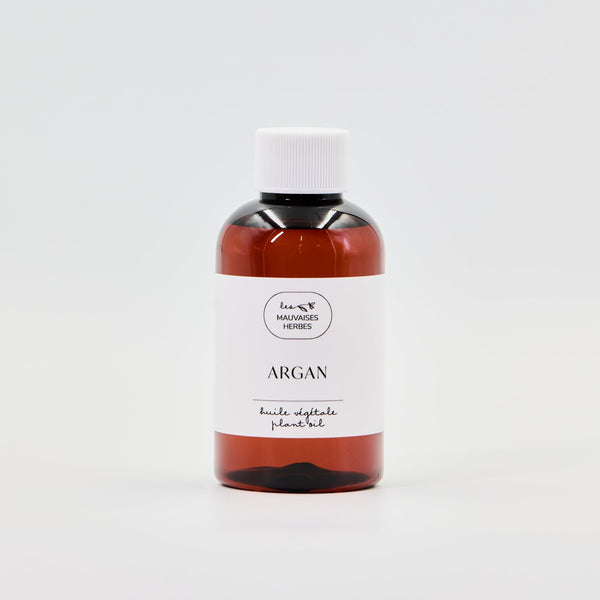
Our organic argan oil comes from Morocco, from a certified organic supplier, and is available in 55 ml and 125 ml. It’s a virgin oil: it has a strong natural scent, which we warn you about up front (some people love it, others less so).

A few ideas: one or two drops in your palm, applied to your face while it’s still damp after your routine. A few drops in your cream to make it more enveloping. A little on the ends of your hair. As with any oil, start small, then adjust to what your skin likes.

Our product page also presents it as an alternative to sweet almond oil. And if you prefer a drier, lighter feel, there’s our Abyssinian oil.

Huile d'argan bio - Les Mauvaises Herbes
skincare oil

Organic argan oil

Regular price From 25.99 $
From 25.99 $
Sale price
Regular price
Unit price
(137 reviews)

To learn more

  • UNESCO. Argan, practices and know-how concerning the argan tree. Representative List of the Intangible Cultural Heritage of Humanity, 2014.
  • Boucetta K.Q. et al. (2014). Skin hydration in postmenopausal women: argan oil benefit with oral and/or topical use. Menopause Review, 13(5).
  • Boucetta K.Q. et al. (2015). The effect of dietary and/or cosmetic argan oil on postmenopausal skin elasticity. Clinical Interventions in Aging, 10, 339-349.
  • Baumann L. Update on argan oil. Dermatology, review article on composition, uses and studies.
  • Exploring the Impact of Extraction Methods on the Nutritional and Sensory Profiles of Argan Oil from Mostaganem Kernels, for the sterols and the authenticity of the oil.
  • Argan (Wikipedia), for the tree, the goats and traditional uses.
  • Taguchi K. et al. (1999). Enhancement of Propylene Glycol Distribution in the Skin by High Purity cis-Unsaturated Fatty Acids with Different Alkyl Chain Lengths Having Different Double Bond Position. Biological and Pharmaceutical Bulletin, 22(4), 407-411.
  • Naik A. et al. (1995). Mechanism of oleic acid-induced skin penetration enhancement in vivo in humans. Journal of Controlled Release, 37(3), 299-306.

While you're drinking your coffee, you could also read 👇

  • Blog
    Huile d’argan : qu’est-ce qu’elle a de si spécial, au juste? Huile d’argan : qu’est-ce qu’elle a de si spécial, au juste?

    Argan oil: what’s so special about it, exactly?

    An oil you find in shampoos, creams, serums, balms… and, in Morocco, on the plate, spread on bread. An oil with its own tree, its own cultural heritage and its...

    Read more : Argan oil: what’s so special about it, exactly?
  • Blog
    Huile d’abyssinie : une huile sèche cultivée au Canada Huile d’abyssinie : une huile sèche cultivée au Canada

    Abyssinian oil: what is a “dry” oil, exactly?

    A plant from ancient Abyssinia (that’s the old historical name for Ethiopia). An oil often compared to a silicone… plant-based version. Plus a texture that can seem contradictory: dry. Yes,...

    Read more : Abyssinian oil: what is a “dry” oil, exactly?
  • Blog
    Acide hyaluronique : est-ce que le poids moléculaire change vraiment quelque chose? Acide hyaluronique : est-ce que le poids moléculaire change vraiment quelque chose?

    Hyaluronic acid: does molecular weight really change anything?

    Hyaluronic acid: you’ve almost certainly come across it. In serums, in creams, even the most generic ones at the drugstore. It’s become so common that you could almost stop seeing...

    Read more : Hyaluronic acid: does molecular weight really change anything?
View all
Invalid password
Enter
Practical information
  • contact us
  • frequently asked questions
  • Terms and sales policies
  • privacy policy
  • Legal notice
Quick links
  • best sellers
  • What's New
  • Sales
  • recipes
  • Facebook group
about
  • our story
  • our points of sale
  • become a retailer
  • job offer
  • distribution placeholder
Sign up for our newsletter (french only for now)

Apparently we're funny. And yes: there's a 10% discount if you sign up.

  • Apple Pay
  • Diners Club
  • Discover
  • Google Pay
  • Mastercard
  • PayPal
  • Shop Pay
  • Visa

© 2026 - Les Mauvaises Herbes – Made with love in Quebec 🌱

Your cart

Your cart is empty

Continue shopping
Have an account?

Log in to check out faster.

Loading...

Localization options
  • Country/region
  • Language
Canada | CAD $

You are currently shipping to Canada and your order will be billed in CAD $.

  • Choosing a selection results in a full page refresh.
View all details


Notification Channels