Posted by Les Mauvaises Herbes

A mushroom that looks like a jellyfish. That grows on dead branches. That people eat as a sweet soup in China AND that you’ll find in a serum made in Montreal. Huh? Yep, yep!
Let us introduce you to a REALLY interesting ingredient.
Here’s our starting point: its polysaccharides love water, which is what makes it an interesting ingredient for a hydrating serum, like the one we just launched with hyaluronic acid.
First off, what is Tremella?
Tremella (Tremella fuciformis to its friends) is an edible mushroom with a translucent, gelatinous texture. It looks like a big blob of glue, or some kind of weird jellyfish.
It goes by a lot of names. In English: snow mushroom, silver ear or white jelly mushroom. In French: champignon des neiges, oreille d’argent, or champignon de beauté (“beauty mushroom”). In Mandarin, yín’ěr, which also means “silver ear”. In Japan, it’s shiro kikurage, literally “white tree jellyfish”. We weren’t the first to think of jellyfish!

On the mycology side, it’s a weird little critter. It grows on dead branches of broadleaf trees, mostly in tropical and subtropical regions. It’s a dimorphic fungus: it can live in two forms. It starts out as a yeast that looks like a kind of slimy film, until it meets a host fungus (an Annulohypoxylon, for the curious). It moves in, and only then does it form its gelatinous “flower” (its second form). It can’t make a mushroom on its own!
That’s actually how it’s grown. In China, since at least the 19th century, growers have raised Tremella AND its host fungus together on sawdust. A mandatory duo.
What did people do with it before serums?
Tremella has a long history in China. Sources don’t agree on its first written mention: some point to the Shennong Bencao Jing, one of the oldest classics of Chinese medicine (from the first centuries CE), others to the Tang dynasty (618 to 907). It also appears in the Bencao Gangmu, Li Shizhen’s great compendium, from the 16th century.
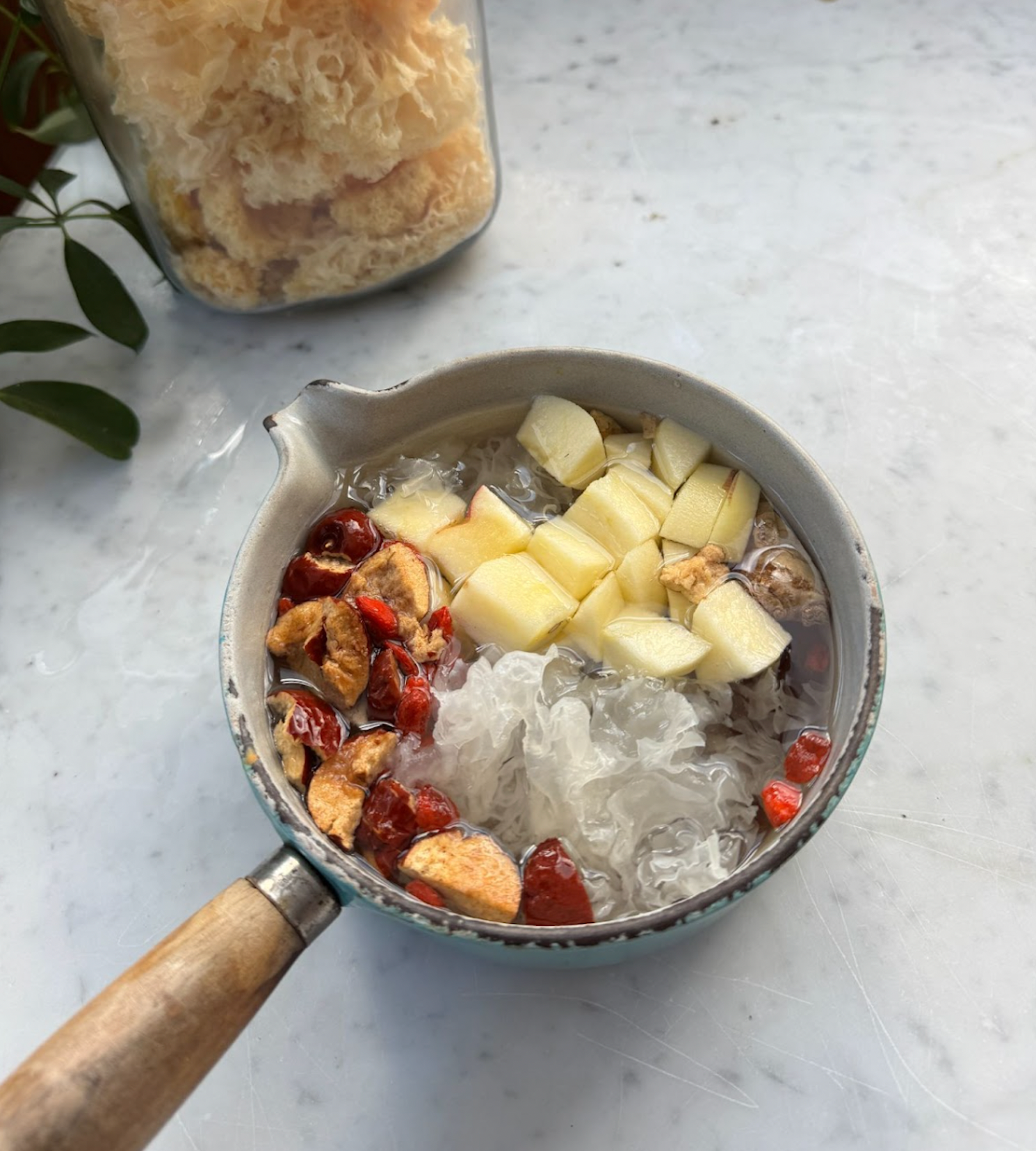
In Chinese medicine, it’s classified among the yin tonics, remedies associated with the lungs and the stomach, built around the idea of moistening and nourishing. It also had its place at the table, in sweet dessert soups, often with jujubes and dried longans. It barely tastes like anything: it’s chosen for its texture. Legend even has it that Yang Guifei, an imperial concubine under the Tang dynasty famous for her beauty, ate it to keep her complexion.
Today, it’s still eaten in China, and in Vietnam too, in desserts (called chè). Since farming has made it cheaper, it even shows up in a few savory dishes. You’ll also find it in beauty products from China, Korea and Japan.
Polysaccharides, the real star
When we talk about Tremella in skincare, we’re mostly talking about its polysaccharides. That’s the fancy word for long chains of sugars. In Tremella, they’re made of mannose, xylose, glucuronic acid and a few other sugars. Glucuronic acid, in particular, gives these chains a negative charge and a nice affinity for water.
Hyaluronic acid is also a long chain of sugars. That’s why people are always comparing the two. Spoiler: we’ve got an article on that too.
Another detail: two Tremella extracts can be very different from each other. The strain, how it’s grown, how it’s extracted and purified: all of it affects the size and structure of the molecules. A 2021 review notes, for example, that polysaccharides taken from the body of the mushroom are much larger than those obtained through fermentation in a tank. And a 2026 study reminds us that you can’t assume all commercial extracts are equal. For our part, we use a standardized Tremella extract from a supplier we’ve worked with for a long time (and in whom we have complete confidence!).
This business about molecule size is called molecular weight. Remember that term, because we go into it in detail in our article on hyaluronic acid here.
How does Tremella work on the skin?
Surface hydration. This is what’s described most often. Tremella polysaccharides hold on to water and form a hydrophilic film on the skin, which could help keep it hydrated and limit water loss. A 2026 study presents this ability as the best-established cosmetic property of the ingredient. You’ll also find the extract in beauty products from China, Korea and Japan.
What we’ve seen in the lab. Researchers tested Tremella polysaccharides on cultured human skin cells (fibroblasts). When oxidative stress was induced with hydrogen peroxide, cells treated with Tremella beforehand showed less oxidative stress and less cell death.
There’s also research on other medicinal uses of Tremella, mostly taken orally. We won’t get into that here, though. We’re sticking to skin.
And in our serum, what does it do?
Our starting point: minimalist serums. Few ingredients, but active ones, chosen to earn their place in the formula. We see them as routine boosters, add-ons to what you’re already doing.
Our new water-based serum pairs Tremella with hyaluronic acid. Both have an affinity for water, but they’re different molecules. The idea is to bring two families of hydrophilic ingredients together in one product, to maximize hydration.
Also, a study published in 2026 compared a commercial Tremella extract with hyaluronic acid on human fibroblasts in the lab. The researchers observed effects that partly overlap, but also differences between the two ingredients. That suggests they aren’t interchangeable. Does combining them bring an extra benefit for the skin? The study can’t tell us, but it’s really, really interesting!
How to use it? You can add it to your existing routine, or use it as is. Plenty of our customers apply a water-based serum, followed by an oil-based serum, and that’s it. Because water-based serums contain a lot of water, we recommend following them with a product that contains an oil. For the rest of your routine, we’ve got an article on that.

Next up: check out our article on hyaluronic acid, and why its molecular weight makes all the difference.
To learn more
- Wolosik K. et al. (2026). Tremella fuciformis Extract Evokes Similar Effect as Hyaluronic Acid on Wound Healing but Through Different Mechanisms in Human Dermal Fibroblasts. Molecules, 31(13).
- Ma X. et al. (2021). A review on the production, structure, bioactivities and applications of Tremella polysaccharides. International Journal of Immunopathology and Pharmacology, 35.
- Mineroff J., Jagdeo J. (2023). The potential cutaneous benefits of Tremella fuciformis. Archives of Dermatological Research, 315(7).
- Shen T. et al. (2017). Tremella fuciformis polysaccharide suppresses hydrogen peroxide-triggered injury of human skin fibroblasts via upregulation of SIRT1. Molecular Medicine Reports, 16(2).
- Tremella fuciformis (Wikipedia, in English), for the mycology, names and cultivation of the mushroom.


